Civil infrastructure: why community journalism and philanthropy matter
October 08, 2026
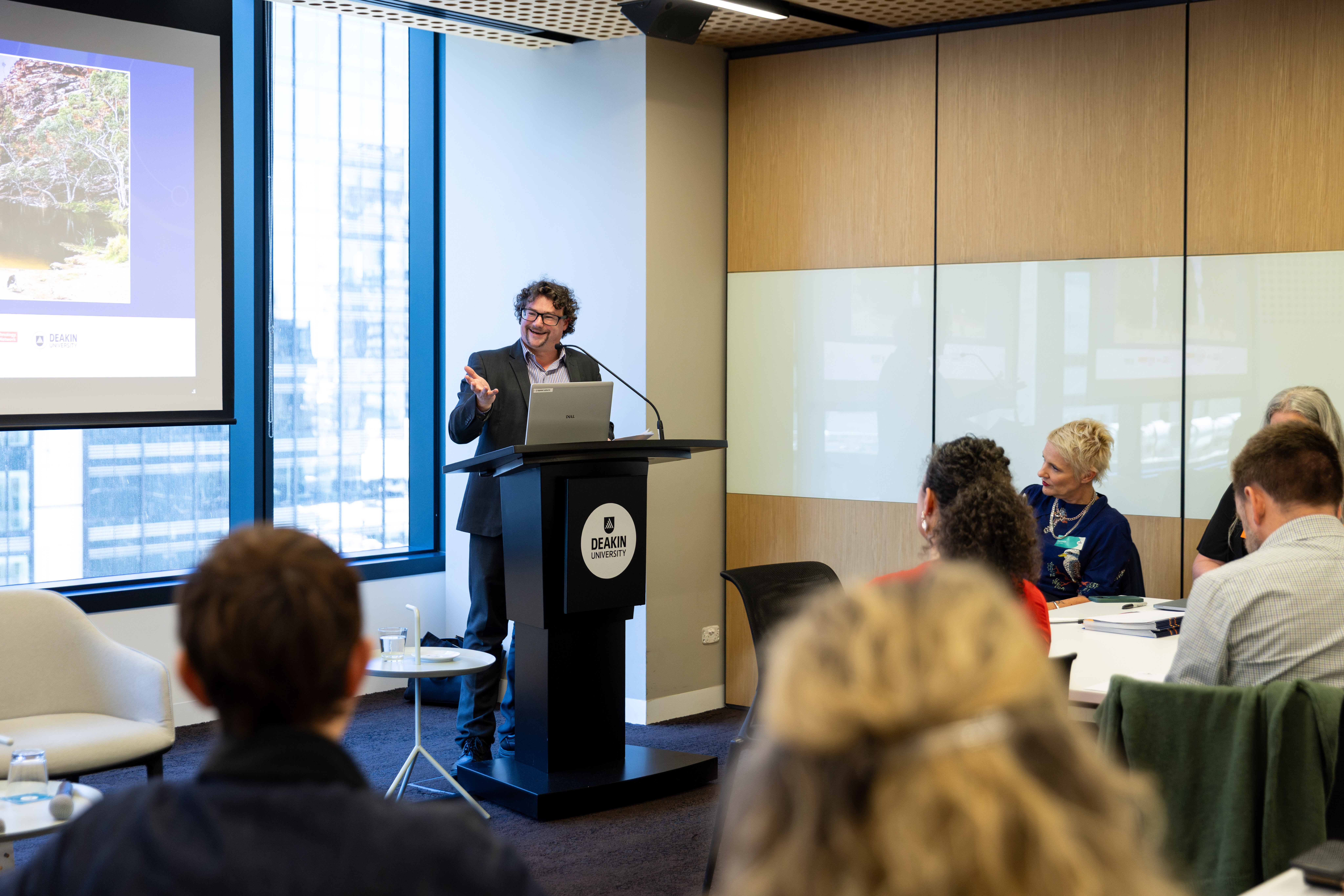
Ballarat Foundation CEO Andrew Eales addresses the workshop in Melbourne on October 8. Phot: Matt Houston.
This is an edited version of a speech delivered by Ballarat Foundation CEO Andrew Eales to an Engaged Journalism workshop hosted by University of Canberra News and Media Research Centre, Deakin University and RMIT.
-----
It’s a real pleasure to be here, particularly because the subject brings together two parts of my working life that have shaped how I think about communities.
For much of my career, I worked in regional journalism. I was editor of The Courier here in Ballarat, and later Managing Editor with Australian Community Media, responsible for mastheads across Victoria and southern New South Wales.
In late 2019, I met the fate so many in the industry of my generation faced – I was made redundant. Fortuitously, I moved from journalism into philanthropy, becoming CEO of the Ballarat Foundation in early 2020, just before the onset of the COVID pandemic. These indeed were interesting times.
I sometimes describe that move as going from “the dark side to the light”. But the truth is that I don’t see these as two entirely separate worlds.
Journalism and community philanthropy are both connected to a fundamental question: what does it take for a community to understand itself, respond to its challenges and shape its own future?
My experience in both fields has led me to think that the decline of regional journalism is about much more than the loss of newspapers or news products.
It is also about the weakening of relationships, shared civic spaces and local institutions that help communities stay connected.
And I want to explore that today through three perspectives: what I experienced in regional journalism; what I have learned through community philanthropy; and what we might do together to strengthen the civic life of regional communities.
Journalism was never just about producing a newspaper
When I think back to my time in regional journalism, I think first about relationships.
A regional newspaper was a product, of course. It had deadlines, circulation figures, advertising targets and production costs. But its place in a community was much bigger than that.
It was a record of local life.
It reported on council decisions and local controversies. It covered school concerts, sporting clubs, community campaigns, business openings, fundraising efforts and the achievements of people who might never appear in a metropolitan newspaper.
It gave people a way to see themselves and their neighbours reflected in a shared public space.
And it created a relationship between a community and the people responsible for telling its stories.
That relationship was never perfect. Regional newspapers could overlook people and issues. They could reflect the interests and assumptions of their owners, advertisers or editors. They could be too close to local power, or not close enough to particular parts of the community.
They were also a lightning rod for capturing community sentiment. And it won't be a surprise to anyone in this room – but it wasn't always positive.
As editor of The Courier in Ballarat, we had led reporting on clergy sexual abuse for a decade before the Victorian Royal Commission. In our office, each fortnight the workplace would bring in pastoral care support. Sister Joan, recently departed, rest her soul would wander into my office and provide feedback on how the newsroom team was "coping" with the hard work they were undertaking.
Often, the advice would veer from staff wellbeing into the murky depths of the impact our reporting was having on the wider Catholic population in the Ballarat region.
As the editor of the local newspaper, you kept your friends close and your enemies closer.
I didn't feel like I had a choice. I'd been to interview victims of clergy abuse and knew their stories were much more important than those who would want them silenced.
When you sit in the lounge room of an abuse victim at 10am in the morning and have a straight scotch with them because that's the only way they can get through the day, it hits hard.
I remember writing stories such as these knowing I couldn't publish their names or identifying details – not because they asked me to – but because our legal system prevented it.
Today, that's not the case.
It's not the case because reporting by journalists in communities like Newcastle, Ballarat, Warrnambool and many others across regional Australia made a case which could not be ignored.
Good regional journalism creates positive change for the community it serves.
At our best, newspapers were uniquely positioned to lead. We had local knowledge built over time; we had strong and diverse readership and we had a purpose which prioritised building and improving community.
Journalists knew the people involved. They understood the history behind an issue. They knew which questions had been asked before, which promises had been made, and what was at stake for the people affected.
That knowledge is difficult to replicate quickly. It comes from being present, listening, following up and being accountable to the same community day after day.
The digital transition
One of my most significant professional experiences was participating as a leader in the transition of a large number of small, legacy print mastheads into digital-first publishing outlets at Australian Community Media.
This was not simply a matter of moving stories from print to a website.
It required us to rethink how newsrooms operated, how journalists worked, what skills they needed, how stories were produced and how we structured our teams.
We had to restructure and reskill across regional mastheads. We had to find new ways to serve audiences whose expectations and media habits were changing, while operating in an environment where the economics of traditional print journalism were under enormous pressure.
There were real opportunities in that transition. Digital publishing could make local journalism more immediate and accessible. It could help journalists reach audiences throughout the day rather than waiting for the next print edition. It created new ways to tell stories and engage with readers.
But there was also a difficult operational question: how do you make a regional news operation more efficient without losing the local knowledge and presence that made it valuable in the first place?
When you consolidate production, change roles or reduce the number of people physically based in a community, you may achieve efficiencies. But there can be a cost that does not show up neatly in a budget.
You may lose the person who knows the local sporting clubs, the community groups, the council history and the people who are usually not the first to contact a newsroom.
You may lose the casual conversation that reveals a story before it becomes a formal announcement.
You may lose the journalist who can recognise that something happening today is part of a much bigger story.
The challenge, then and now, is not to resist change. It is to understand what must be preserved through change.
Because a newsroom’s value is not only in the stories it publishes. It is also in the relationships and local understanding that enable those stories to be found, investigated and told.
The most pertinent call out I can make right now is to gaze at the volcanic division created by the renewables transition. It's an issue for the world ... but breakdown where it hits hardest and that is in regional communities hosting turbines, transmission lines, solar farms and energy storage facilities.
The division is reflected in the disintegration of the two-party election polling in regional areas. But it’s mostly reflected in the neighbor against neighbor war that is ripping regional communities apart.
It's being fed by mis- and dis-information on social media and with little to zero metropolitan care factor and little regional media capacity to cover the issue in the depth it requires.
There's an epic story here right now about power, politics and the future of regional and rural communities and, in my view, it simply deserves much deeper and nuanced consideration.
When local institutions weaken, communities lose more than services
That brings me to a broader change I think we need to consider.
Across regional communities, we have seen many familiar local institutions change, consolidate, move or disappear.
The local newspaper is one example. But it sits alongside other places and services that have traditionally helped organise community life: post offices, bank branches, council service points, pubs, schools, neighbourhood houses, sporting clubs and community halls.
These institutions are different, and the reasons they change are different. Centralising services can bring efficiencies, improve consistency or make better use of limited resources. Not every local institution can or should remain exactly as it was.
But we need to consider the social consequences as well as the operational ones.
A local service point is not only somewhere to complete a transaction. It may also be somewhere you see a neighbour, ask a question, hear about a community event or discover that someone nearby needs help.
A local newspaper is not only a way to receive information. It can provide a common reference point: a shared account of what is happening, what is being debated and what decisions are being made.
When those places disappear or become less accessible, the loss can be cumulative.
In my experience at Australian Community Media, this was and continues to be a fatal failing of the restructure which occurred through the digital transition of the past 20 years.
It wasn't really the loss of printed products or shift of deadlines to meet the Facebook algorithm which was problematic. The first pillar to fall was the disintegration of community connection, created through the centralisation of decision-making which precipitated a loss in local trust.
The loss of local trust accelerated the loss of local advertising and with social media giants infiltrating on national and international levels, the conditions for change were – and remain - unstoppable.
Central to the success of regional media has always been the journalism. The rivers of gold did not flow on a platform, it wound its way alongside the content.
The second pillar in the demise was that transformation in regional media didn't centre journalism in its purpose – it focused on managing the decline of failed business models.
People may still have access to information online. They may still be able to contact an organisation through a central phone number or digital service. But the informal opportunities to connect, ask questions and build familiarity may become less frequent.
And that matters because community connection is often built through ordinary, repeated contact rather than through formal programs.
It is built when people encounter each other in familiar places, when they recognise one another, when they have small conversations and when they develop enough trust to ask for help or work together.
We should be careful not to romanticise the past. Traditional institutions did not serve everyone equally, and some people experienced them as exclusionary or inaccessible. Nor should we assume that every local service or organisation can remain unchanged.
But we should ask a serious question: when we remove or centralise a local institution, what else are we removing that may be harder to see and harder to replace?
That question applies to journalism, but it also applies to the wider civic environment in which journalism operates.
Trust, local government and the need for shared understanding
One of the important roles of regional journalism has been to help people understand decisions that affect their lives.
Local government is a good example.
Councils are among the institutions closest to people’s everyday experience. They make decisions about roads, planning, parks, libraries, waste, community facilities and local services.
They are also places where people can have strong and sometimes conflicting views about what their community needs.
In some communities, local government debates have become more politically charged. That does not mean disagreement is itself a problem. Disagreement is part of democratic life. People should be able to challenge decisions, question priorities and hold elected representatives accountable.
The question is whether people believe they can be heard, whether they can understand how decisions are made, and whether there is a credible public process through which competing views can be examined.
Journalism has an important role here. And it's concerning that media outlets themselves are making decisions about de-prioritising local council reporting by using it as a test bed for AI.
I'm not from the old school world which baulks at new technology. Indeed, I believe we must embrace the digital world to support modern journalism. But given what we've seen from commercial media outlets in recent years, the words written by executives suggesting AI won't replace human resources is simply not worth the paper it is printed on.
History tells us that technology will continue to improve and influence our lives and jobs in both positive and negative ways. It's inevitable and if harnessed appropriately can support better journalism. The key variable here is the capacity for appropriate harnessing – there's few examples in an Australian context that regional and rural communities are better served by journalism now than we were 20 years ago.
Good journalism can explain the decisions and the trade-offs. It can scrutinise those in power. It can make room for different perspectives without pretending that all claims are equally supported by evidence.
And it can help people understand not only what has happened, but why it matters and what happens next.
When local reporting is reduced, communities can lose some of that shared explanatory capacity.
Information may still be available through official announcements, social media posts or individual advocacy. But those sources do not necessarily provide independent scrutiny or a common account that people with different views can examine together.
That creates a challenge for the whole community.
If people no longer share a basic understanding of what is happening locally, it becomes harder to have constructive disagreements about what should happen next.
And that is where I think the conversation about journalism connects with the conversation about civic trust.
Trust is not something we can simply ask people to have. It is built through experience: through institutions being present, listening, explaining themselves and demonstrating that they are accountable.
It is also built through relationships between people who may not agree with one another.
What I have learned through community philanthropy
Since moving into philanthropy, I have had the opportunity to see community life from a different perspective.
The Ballarat Foundation is a community foundation. We bring together people who want to contribute to the future of Ballarat and the surrounding region, and we work with local organisations, donors, businesses, government and community members to direct resources towards local needs and opportunities.
Our work includes grantmaking, but I increasingly see our role as broader than distributing funds.
We can help connect people who might not otherwise work together. We can support organisations to collaborate. We can bring attention to issues that require a longer-term response. We can help communities build the relationships and capacity needed to address challenges that no single organisation can solve alone.
In that sense, a community foundation can become part of a community’s civic infrastructure.
Not a replacement for government. Not a substitute for independent journalism. Not the organisation that gets to decide what a community should think or what its future should be.
But a locally rooted institution that can help people come together, build relationships and turn shared concern into practical action.
One example is the Ballarat Foundation Giving Hub at Hugh Williamson House.
The Hub provides a shared home for community organisations and creates opportunities for connection, collaboration and the exchange of ideas.
The important part is not simply that organisations share a building. It is that they have opportunities to develop relationships that can lead to work they might not have been able to do independently.
For example, Respect Victoria is a tenant at the Hub. As is Ballarat Neighbourhood Centre and the Western Bulldogs Community Foundation. We are all working in one way or another in support of Respect Ballarat, a local initiative focused on preventing violence against women and building a culture of respect.
This is one simple example of how a shared place can help make connections possible. It is not a guarantee that collaboration will happen, and it is not a substitute for the expertise and leadership of the organisations involved. But it creates the conditions in which relationships can develop.
I think there is a parallel here with journalism.
The value of a newsroom is not only the output it produces. The value of a community hub is not only the services delivered within its walls.
Both can create opportunities for people to encounter one another, develop trust and discover things they could not have achieved alone.
Another project that has shaped my thinking is the Ballarat Civility Exchange, a partnership between the Ballarat Foundation and the Menzies Leadership Foundation.
The project began in July 2025 and grew out of the Menzies Leadership Foundation’s Reimagining a Civil Society initiative. Ballarat became its first place-based partner.
At its heart is a question that sounds simple but is actually quite difficult:
What does it look like for people in a regional community to have constructive conversations when they disagree?
We are not trying to create a community where everyone agrees. Nor are we suggesting that civility means avoiding difficult issues, softening legitimate criticism or asking people to be polite at the expense of honesty.
A healthy community needs disagreement. It needs people who challenge decisions, question assumptions and speak from different experiences.
But there is a difference between disagreement that helps us understand an issue and disagreement that makes it impossible to hear one another.
There is a difference between challenging someone’s argument and treating them as an enemy.
The Civility Exchange is exploring how communities can create spaces and practices that make it possible to remain in conversation across difference.
That includes asking what conditions help people feel heard, what makes a conversation feel safe enough to be honest, and what enables people to stay engaged when they encounter a view they strongly oppose.
For a community foundation, this work is connected to our broader role as a convener. We can bring people together who might not ordinarily meet, and we can help create the conditions for a conversation without determining its outcome.
But this is also where I see an important relationship with journalism.
Journalism can expose people to perspectives beyond their immediate networks. It can challenge assumptions, investigate claims and provide information that makes public debate more informed.
Community conversations can help people make sense of those issues together, particularly when the issues are complex, emotionally charged or deeply connected to local identity.
These roles are complementary, but they are not interchangeable.
A journalist must be free to investigate the foundation, the organisations involved, the people funding the work and the decisions being made. A foundation must not expect positive coverage in return for convening or funding a project.
The value lies in each institution doing its own job well, while recognising that both contribute to the civic life of the community.
Alice Springs: a community foundation responding to the loss of local connection
As Kristy mentioned earlier, the experience of Mparntwe Alice Springs offers another example of the connection between local journalism and community life.
What I find significant here is not simply that a community foundation became involved in a newspaper-related initiative.
It is that the foundation recognised the newspaper as part of the community’s civic infrastructure: something connected to local identity, shared understanding and the ability of people to imagine a future together.
A community foundation cannot replace independent journalism and philanthropy alone cannot solve the economic challenges facing local media.
But the Alice Springs example does show how a locally rooted foundation can help a community recognise what is being lost, bring people together around that loss, and support community-led action.
The ARC project provides another opportunity for community foundations to explore this relationship and it's one that personally I'm keen to be involved with.
Where does all this lead us? Well, let's go back to the central question for this workshop:
When local journalism weakens, who helps a community maintain the relationships, shared knowledge and civic connections that journalism has long helped sustain?
Could community foundations support local journalism?
I think community foundations have a potential role to play here, but we need to be clear about both the opportunity and the limits.
Community foundations are locally connected. They often have relationships with donors, community organisations, businesses and local leaders. They may have the capacity to convene conversations about local needs and to support projects that are important to the community but difficult to fund through conventional commercial models.
That could include supporting local journalism.
For example, a foundation might help convene a conversation about the community’s information needs. It might support a locally relevant reporting project, help build a partnership between a newsroom and a university, or contribute to a fund that supports journalism addressing a clearly identified local gap.
It might also support community engagement activities that help journalists hear from people whose experiences are not routinely represented in public debate.
But the design of any such work matters enormously.
Editorial independence must be protected.
A donor should not be able to determine what gets covered. A foundation should not be able to influence a story because it funds a project. Journalists must remain free to scrutinise the foundation itself, its donors, its partners and the powerful interests within the community.
There needs to be transparency about funding, clear governance and a proper separation between philanthropic support and editorial decisions.
And we should avoid assuming that community foundations can solve the structural economics of journalism. They cannot replace sustainable business models, public policy or the need for strong, independent media organisations.
Nor should every community be expected to adopt the same model.
A regional town’s information needs, media landscape and philanthropic capacity will be different from those of another town. The response should be shaped locally, with the people who live there and understand its context.
But I do think community foundations can help ask the question: what does our community need to know, and what institutions and relationships will help us know it?
That question could become a starting point for practical collaboration.
Engaged journalism: more than asking people to participate
The phrase “engaged journalism” can mean different things, but I think it becomes particularly powerful when we connect it to the relationships we have been discussing.
Engagement is not simply asking people to comment on a story, respond to a poll or attend a public meeting.
It is about developing a sustained understanding of the community: who is involved, who is missing, what people are concerned about, what they already know, and what they need from journalism.
It means recognising that the community is not a single audience with a single point of view.
A regional community contains people with different experiences of power, different levels of trust in institutions, different access to information and different opportunities to have their voices heard.
Some people will be confident about contacting a newsroom. Others may feel that their concerns are unlikely to be taken seriously. Some may be highly visible in public debate, while others are rarely represented.
Engaged journalism needs to consider those differences.
I would suggest a few practical principles.
First, start with local information needs. Ask people what they need to understand about their community, not only what they want to read or watch. Those questions may reveal gaps that are not obvious from audience analytics alone.
Second, invest in relationships over time. A one-off consultation can be useful, but trust is built through repeated contact, follow-up and accountability. People need to see that their participation has been taken seriously, even when the outcome is not what they hoped for.
Third, look for partnerships without surrendering independence. Journalists, community foundations, universities, neighbourhood houses and community organisations may each bring different knowledge and capabilities. Collaboration can create opportunities, but the roles and boundaries need to be clear.
Fourth, think beyond reach and engagement metrics. Clicks, views and attendance can tell us something, but they do not necessarily tell us whether people understand an issue better, whether overlooked voices have been heard, or whether the community has developed a stronger capacity to discuss difficult questions.
And finally, make room for disagreement.
The purpose of engagement should not be to make journalism more comfortable for the people it covers. Nor should it be to create a false sense of consensus.
A community needs journalism that can challenge it.
But it also needs journalism that understands it.
Engagement and independence must remain in balance
I want to pause on that distinction, because I think it is essential.
Being part of a community does not mean being captured by it.
Regional journalists may live in the communities they cover. They may know the people involved in a story. They may have longstanding relationships with local organisations and leaders.
Those connections can be a source of insight. They can also create pressures.
The responsibility of journalism is not to protect the reputation of a community, or to make everyone feel represented in every story. It is to report accurately, fairly and independently, and to scrutinise power.
Engagement should strengthen that work, not weaken it.
Likewise, community foundations need to be careful about their own position. We often work through relationships, and we rely on trust. But we cannot allow the desire to maintain relationships to prevent us from addressing difficult issues or hearing perspectives that challenge our assumptions.
For both journalism and philanthropy, the test is not whether everyone is comfortable.
It is whether people can see that the institution is acting with integrity, listening seriously and being accountable for its decisions.
What might we do next?
So, where does this leave us?
I don’t think there is one model that will work everywhere. The circumstances of regional communities vary, and the future of local journalism will require a range of responses.
But I do think there are some useful questions we can ask together.
What local information is essential for our community to function well?
Who is currently providing that information, and where are the gaps?
Which people and groups are not being heard, and why?
What local institutions could help create stronger connections between journalists and communities?
Could community foundations help convene or support locally designed journalism initiatives while protecting editorial independence?
How might we evaluate whether those initiatives are strengthening public understanding and civic participation, rather than simply counting outputs?
These are not questions for community foundations alone. They involve journalists, media organisations, universities, local government, community organisations, philanthropic partners and, most importantly, the communities themselves.
The point is not to create another layer of institutions or another set of meetings.
It is to recognise that journalism is part of a wider civic ecosystem, and that the health of that ecosystem matters.
The question is not only how we save local journalism. It is this:
What would our communities miss if local journalism disappeared, and what are we prepared to do together to protect those things?
Because when we talk about the future of regional journalism, we are also talking about the future of regional communities: their capacity to understand themselves, to disagree constructively, to respond to change and to shape a shared future.

We work on Wadawurrung land
The Ballarat Foundation acknowledges the Wadawurrung people, the Traditional Owners of the lands and waterways in our region. We recognise their diversity, resilience, and the ongoing place that Aboriginal and Torres Strait Islander people hold in our communities. We pay our respects to Elders, both past and present, and commit to working together in the spirit of mutual understanding, respect and reconciliation.
The Ballarat Foundation is committed to fostering a diverse, equitable and inclusive community where everyone is welcomed, respected and empowered to thrive.